September 2, 2026
5 minute read
Hybrid work is no longer the experiment it was a few years ago—it’s simply how business gets done. But there’s a gap most teams still haven’t solved: where do you actually go when working from home isn’t cutting it and the coffee shop down the street isn’t a place you’d bring a client? For hybrid teams in 2026, the answer increasingly isn’t a long-term lease or a laptop wedged between two strangers ordering oat milk lattes. It’s a coworking space built for the way you actually work.
This guide breaks down why a professional coworking space outperforms the coffee-shop-and-couch routine, and how hybrid teams can put flexible space to work—for focus, for privacy, and for the kind of professionalism that wins business.
The coffee shop became the unofficial office of remote work for one reason: it was free and available. But “free” comes with a hidden invoice.
Noise you can’t control. A background espresso grinder is charming until you’re on a client call and it fires up mid-sentence. Coffee shops are built for turnover and ambient chatter, not concentration.
No privacy. Sensitive conversations, confidential documents, screen-sharing with strangers reading over your shoulder—none of it works when your “office” is a shared table in a public room. For attorneys, financial advisors, healthcare practitioners, and consultants, that’s not an inconvenience; it’s a liability.
No professional footing. When a prospective client asks to meet, “let’s grab a table at the café” sends a very different signal than walking them into a polished, staffed reception area and a proper meeting room.
Unreliable everything. Wi-Fi that drops. Outlets already claimed. No guarantee of a seat. The coffee shop is a fine place to answer a few emails. It’s a poor place to run a business.
A professional coworking space solves the exact problems the coffee shop creates—and adds a few advantages the café never could.
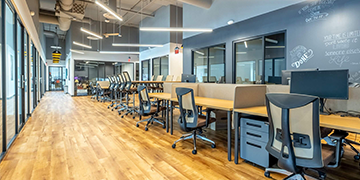
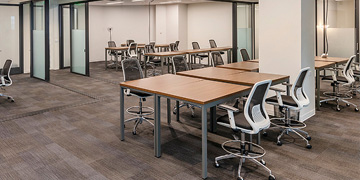
Focus by design. Coworking spaces are engineered for productive work: quiet zones, phone booths for calls, comfortable workstations, and business-class internet that doesn’t buckle when the room fills up. You replace home distractions and café chaos with an environment that keeps you in flow.
Privacy when it counts. Need to take a confidential call or host a sensitive discussion? Step into a phone booth or book a private room. Your work—and your clients’ trust—stays protected.
Professional credibility. A modern, upscale space with staffed reception during business hours tells clients and partners exactly what they need to know: you’re serious, and you’re established. That impression is hard to manufacture from a home office or a corner booth.
Flexibility without the lease. This is the part traditional offices can’t match. Coworking lets hybrid teams pay only for the access they need—day passes, monthly memberships, part-time plans—and scale up or down as the business evolves. No five-year commitment, no build-out, no guessing how much space you’ll need in six months.
Built-in community. There’s a real difference between sitting alone among strangers and working alongside a community of professionals, entrepreneurs, and teams. The networking and collaboration that happen naturally in a well-run coworking space are a genuine business asset, not a nice-to-have.
The single most underused advantage for hybrid teams is on-demand meeting space. When your people are distributed across home offices and different cities, the question isn’t where does everyone sit every day—it’s where do we come together when it matters.
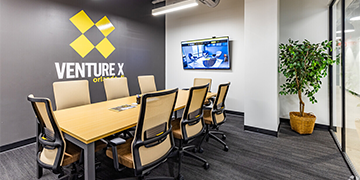
That’s where meeting rooms you can book by the hour change the math. Instead of paying year-round for a conference room you use twice a week, you reserve a fully equipped, tech-ready room exactly when you need it—for the quarterly planning session, the client pitch, the new-hire interview, the project sprint.
A few ways hybrid teams get the most out of flexible meeting space:
Anchor your rhythm. Pick a recurring cadence—weekly, biweekly, monthly—and book the same kind of space for in-person collaboration. Predictable together-time is what keeps hybrid culture from drifting apart.
Reserve for the moments that matter. Client presentations, negotiations, and interviews deserve a professional room with screens, whiteboards, and conferencing tools—not a kitchen table on a webcam. Book up, book down, based on the occasion.
Use offsites and project work strategically. When a team needs to sprint on something together, a dedicated space for a day or a week beats trying to coordinate around everyone’s living rooms.
Meet your clients where you work. On-site reception, a polished setting, and complimentary refreshments turn a routine meeting into an impression that builds trust.
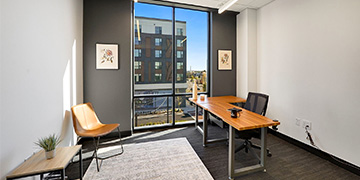
For teams that need more than occasional space, private offices and team and enterprise suites give you a permanent, lockable home base—fully furnished, 24/7 access, and the option to add offices as you grow, all without the drag of a traditional lease.
If you’re a hybrid team deciding how to structure your space this year, it comes down to matching the tool to the need:
For daily individual focus, a coworking membership gives your people a professional place to land—far better than home distractions or a café, with access to spaces nationwide when they travel.
For collaboration and client-facing moments, book flexible meeting rooms as needed, so you’re only paying for premium space when it’s actually earning its keep.
For a permanent team home base, a private office or enterprise suite anchors your culture while keeping the flexibility to scale.
The through-line is flexibility. The traditional office asked you to commit first and hope the space fit. The coffee shop asked you to accept whatever you got. A modern coworking space lets you build exactly the footprint your hybrid team needs—and change it the moment your needs change.
In 2026, hybrid teams don’t have to choose between the isolation of home, the chaos of the coffee shop, and the cost of a traditional lease. A professional coworking space delivers the focus, privacy, and credibility that serious work demands—paired with the flexibility that hybrid work requires. It’s not just a better place to work. It’s a smarter way to run a team.
Ready to see it for yourself? Find a Venture X location near you and book a tour.