September 2, 2026
5 minute read
Growth is the goal—but for a founder or operations leader, growth is also what breaks your workspace. You sign a lease for the team you have, and six months later you’re either crammed into a space that’s too small or paying for empty desks you overshot on. Either way, you guessed wrong, because the future asked you to predict headcount you couldn’t possibly know.
In 2026, the smartest growing teams have stopped guessing. Instead of betting on a fixed space, they choose a flexible workspace that can expand or shrink as the team changes. This guide gives you a step-by-step framework for picking one that actually fits your growth—without locking yourself into a traditional lease.
Before you look at a single space, get honest about your trajectory. The goal isn’t a precise forecast—it’s understanding the shape of your growth.
Ask three questions. Where is the team today? Where is it realistically headed in the next 6 to 12 months? And how confident are you in that number? A funded startup planning to double is a very different case than a bootstrapped team growing steadily and carefully.
The key insight: don’t pick a space for the team you have or the team you hope to have. Pick a workspace model that can accommodate either, because you don’t yet know which one you’ll be. The uncertainty is the whole point—and it’s exactly what flexibility is designed to absorb.
The instinct with a traditional lease is to solve for size: how many square feet do we need? The better question for a growing team is: how easily can this space change size?
A truly scalable office space lets you move between formats as your headcount shifts:
Start lean. A coworking membership or a small private office fits a founding team without over-committing.
Add as you hire. Bring on people this quarter? Add desks or move into a larger private office—without renegotiating a lease or relocating.
Scale into suites. When you outgrow a single room, team offices and enterprise suites—up to a full floor—let you keep growing in the same location, so you never lose your professional home base or force the team to start over somewhere new.
Trim when you need to. Just as important: the ability to right-size down. If a project wraps or plans change, flexible plans let you scale back without penalty—something a traditional lease will never allow.
When you evaluate a space, the question isn’t “does this fit us now?” It’s “how gracefully does this handle us being 30% bigger—or smaller—next year?”
Not every team member needs the same thing, and good flexible office solutions let you mix and match rather than forcing everyone into one mold.
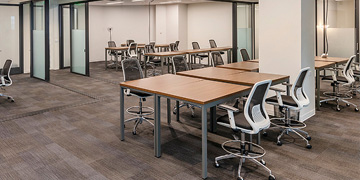
For a distributed or hybrid team, a coworking space membership gives people a professional place to land—individual desks, quiet zones, and business-class Wi-Fi—with the option to drop into locations nationwide when they travel. You pay for the access your team actually uses.
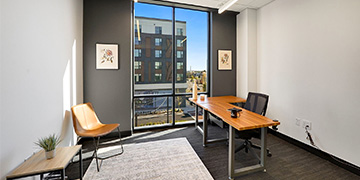
For a core team that needs a daily home base, a private office provides a lockable, furnished space that’s ready from day one, with 24/7 access for the people who keep startup hours.
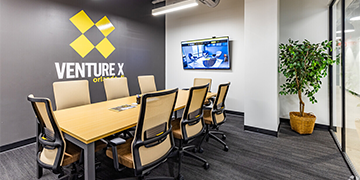
For the moments that matter—investor pitches, all-hands, client presentations, interviews—meeting rooms you book by the hour mean you only pay for premium collaboration space when you actually need it, instead of carrying a conference room year-round.
The framework here: layer the memberships to fit how your team really works. A few private offices for the core, coworking access for the flexible folks, meeting rooms on demand. As the mix shifts, so does your setup.
Flexibility has a price—and understanding it correctly is what separates a good decision from a reactive one.
On paper, a per-desk or per-office membership can look more expensive than a raw square-foot lease rate. But that comparison misses what’s bundled in. A flexible workspace typically includes furniture, utilities, business-class internet, cleaning, staffed reception, meeting rooms, kitchen and lounge access, printing, and a professional business address—all in one predictable payment. Assemble those separately around a traditional lease and the “cheaper” option rarely stays cheaper.
Then factor in the cost you can’t see on a spreadsheet: the risk of being wrong. A three-to-five-year lease on the wrong-size space is a mistake you pay for every month until it expires. Flexible terms let you correct course as you learn—and for a growing team, being able to adapt is worth real money.
Once you’ve mapped your growth, prioritized scalability, matched memberships to your team, and weighed the true cost, the final step is simple: choose the option that gives you the most room to be wrong about the future.
That means favoring:
Office size flexibility—the ability to add or shed space in increments, not all-or-nothing lease commitments.
A location that can grow with you—so scaling up means adding an office down the hall, not signing a new lease across town.
Terms that flex both ways—month-to-month or short-term agreements that let you expand and contract as reality unfolds.
Amenities and services included—so your growing team spends its energy on the business, not on running an office.
Picking workspace for a growing team in 2026 isn’t about finding the right size—it’s about finding the right flexibility. Map your trajectory, prioritize scalability over square footage, layer memberships to fit how your team actually works, and weigh the true cost of being locked in versus staying nimble. Do that, and your workspace becomes something that grows with you instead of something you outgrow.
The traditional lease asks you to commit and hope. A flexible workspace lets you adapt as you go—which, for any team serious about growth, is exactly the advantage worth having.
Ready to find space that grows with your team? Find a Venture X location near you and book a tour.